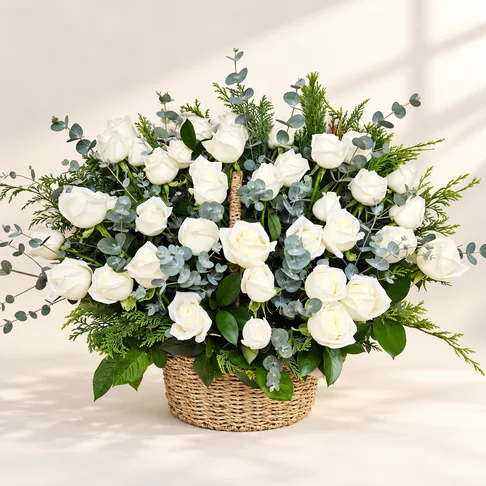
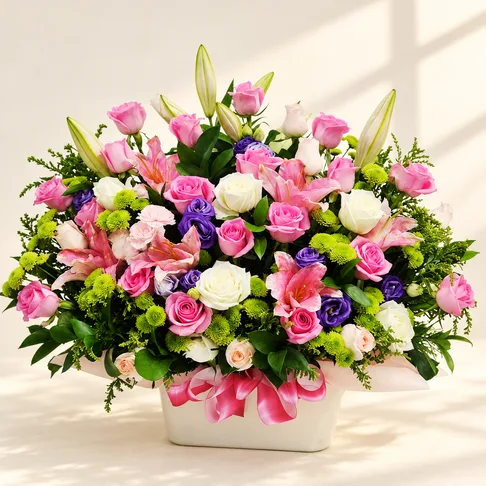
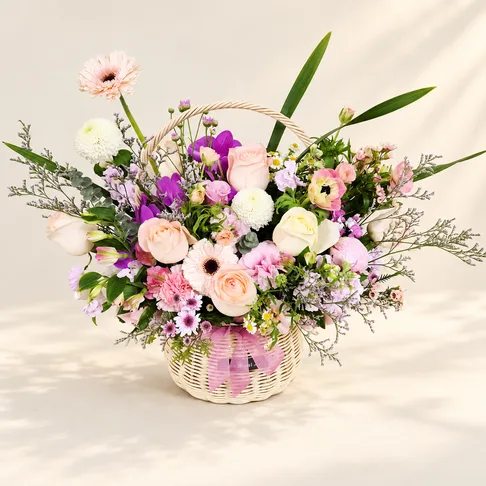
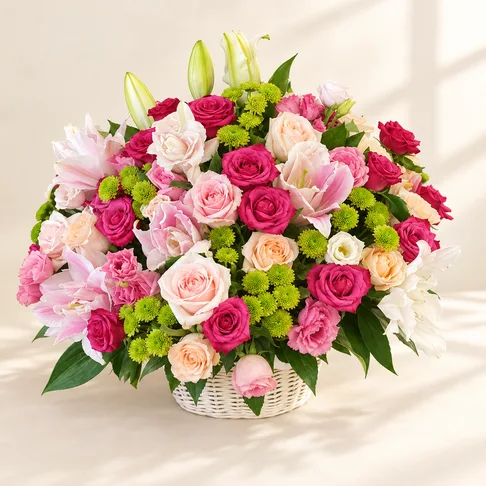
What to Write on a Flower Card for a Korean Recipient
Quick answer
To write a flower card for a Korean recipient, keep it to one or two short lines and, if you can, add one Korean phrase such as 생일 축하해요 (saeng-il chuk-ha-hae-yo, "happy birthday") above your own words. Korea Flower Express can print the card message in a foreign language, mostly English, so you can write in English, in Korean, or in both.
Key points
- Flower baskets and bouquets usually carry a card message; flower stands and plants usually carry a ribbon instead.
- A card can be printed in a foreign language, mostly English, and one line of Korean is a thoughtful extra.
- Use the polite ending (-yo or -ni-da) for anyone older than you, a boss or a business contact; the casual -yo form suits friends and partners.
- Short wins: one Korean phrase, one line in English, and your name.
- Ribbon wording for stands is a separate topic, covered in the ribbon guide.
What can I write on a flower card for a Korean recipient?
On a flower card for a Korean recipient, write one or two short lines about the occasion and sign with your name. At Korea Flower Express, the card message can be printed in a foreign language, mostly English, so write in a language your recipient can read, and a single Korean phrase on top shows you made an effort.
This guide gives ready-to-use Korean phrases with romanization and meaning, explains polite and casual speech, and shows where the card message goes on the order form. The whole ordering process is in How to Send Flowers to Korea From Abroad.
Do baskets and bouquets use a card, and stands use a ribbon?
In the Korea Flower Express order form, flower baskets and bouquets default to a card message, while flower stands, plants, orchids and bonsai default to a ribbon. You can switch between the two on the form if you prefer the other one.
This guide covers the card. A ribbon on a stand has its own conventions: seen from the front, the right side carries the occasion wording and the left side carries the sender. For ribbon phrases, read Korean Wreath Ribbon Messages: Phrases and Sender Names instead, so the two do not get mixed up.
Which Korean phrases work for common occasions?
For a birthday, thanks, love, recovery and graduation, the phrases in the table below are short, natural and safe. Each occasion has a casual-polite version for friends and a formal version for elders or business contacts; when two are shown, the first is the friendlier one.
Romanization is given only so you can read the phrase aloud. We suggest typing the Hangul itself in the card box, because that is what your recipient reads.
| Occasion | Korean | Romanization | Meaning |
|---|---|---|---|
| Birthday | 생일 축하해요 / 생일 축하드립니다 | saeng-il chuk-ha-hae-yo / saeng-il chuk-ha-deu-rim-ni-da | Happy birthday |
| Thanks | 고마워요 / 감사합니다 | go-ma-wo-yo / gam-sa-ham-ni-da | Thank you |
| Missing someone | 보고 싶어요 | bo-go si-peo-yo | I miss you |
| Love | 사랑해요 | sa-rang-hae-yo | I love you |
| Get well | 빨리 낫길 바라요 / 쾌유를 빕니다 | ppal-li nat-gil ba-ra-yo / kwae-yu-reul bim-ni-da | Get well soon / I wish you a speedy recovery |
| Graduation | 졸업 축하해요 / 졸업을 진심으로 축하드립니다 | jol-eop chuk-ha-hae-yo / jol-eop-eul jin-sim-eu-ro chuk-ha-deu-rim-ni-da | Congratulations on your graduation |
| General congratulations | 축하합니다 | chuk-ha-ham-ni-da | Congratulations |
| Parents and elders | 늘 건강하세요 | neul geon-gang-ha-se-yo | Please stay healthy always |
What can I write for a parent, a friend, a partner or a colleague?
Match the sentence to the relationship. For a parent or grandparent, 부모님, 늘 건강하세요. 사랑합니다. (bu-mo-nim, neul geon-gang-ha-se-yo. sa-rang-ham-ni-da) means "Mom and Dad, please stay healthy always. I love you." For a friend of your age, 생일 축하해요. 오늘 하루 행복하세요. (saeng-il chuk-ha-hae-yo. o-neul ha-ru haeng-bok-ha-se-yo) means "Happy birthday. Have a happy day."
For a partner, 보고 싶어요. 사랑해요. (bo-go si-peo-yo. sa-rang-hae-yo) means "I miss you. I love you." For a colleague or business contact, 항상 감사드립니다. 앞으로도 잘 부탁드립니다. (hang-sang gam-sa-deu-rim-ni-da. a-peu-ro-do jal bu-tak-deu-rim-ni-da) means "Thank you always. We look forward to working together." Each of these can sit above one line of English and your name.
Should I use casual or polite Korean on the card?
Use the polite form unless you are sure the recipient is a close friend or a partner of your own age. Korean has speech levels, and an ending that is too casual sounds rude to an older person. The -yo ending (감사해요, 축하해요) is friendly and polite and works for most people; the -ni-da ending (감사합니다, 축하드립니다) is more formal and fits parents, teachers, bosses and business contacts.
If you are unsure, choose the formal version. Addressing a parent or grandparent, 늘 건강하세요 ("please stay healthy always") is a warm line that is polite by itself. For more on what Koreans tend to appreciate in a gift, see Korean Flower Gift Etiquette: Dos and Don'ts.
Should the card be in English, Korean or both?
Both is the safest choice: one line of Korean and one line of English, then your name. A recipient who reads little English still understands the Korean line, and one who reads little Korean still understands the English. Korea Flower Express prints card messages in a foreign language, mostly English, and a line in Korean is a nice extra.
A layout that works well is the Korean phrase first, then a short personal sentence, then "From" and your name. Write the name the way the recipient knows you, because they will not see the order form.
How long should the card message be, and what should I avoid?
Keep the card to a line or two. A card is read in a few seconds when the recipient opens the gift, and a short message looks better printed than a paragraph. We do not set a character count here; if your message is long, tell us in chat and we will check how it fits.
Avoid sympathy wording on a basket or bouquet, and avoid exaggerated promises or jokes the recipient may not read the way you mean them. Funeral wording belongs on a ribbon and has its own rules; Sending Funeral Flowers to Korea From Abroad explains them. For a mother's birthday, see Birthday Flowers for Your Mom in Korea, Sent from Abroad.
Where do I type the card message when I order?
On the Korea Flower Express order form, the message box sits in the recipient section, below the delivery details. For a basket or bouquet it is labelled as a card message; type or paste your text there and check it before paying. You can also open live chat from any country if you want a second pair of eyes on your wording.
Please enter your recipient's mobile number correctly, since the florist may need to reach them. If nobody is home, the flowers are left at the entrance and we send a photo taken on site. Browse Flower Baskets or Bouquets, and compare the two in Flower Basket or Bouquet: Which to Send to Korea?.
Frequently asked questions
Can the flower card be written in English?
Yes. At Korea Flower Express the card message can be printed in a foreign language, mostly English. Adding one line of Korean is a nice extra.
What is a good Korean phrase for a birthday card?
생일 축하해요 (saeng-il chuk-ha-hae-yo) is friendly and polite, and 생일 축하드립니다 (saeng-il chuk-ha-deu-rim-ni-da) is more formal for elders or business contacts.
Do I need to write the card in Hangul or romanization?
We suggest typing the Hangul, since that is what your recipient reads. Use the romanization only to say the phrase yourself.
Does a flower stand have a card too?
Stands normally carry a ribbon rather than a card, with the occasion wording on the right and the sender on the left when seen from the front. The ribbon guide has the phrases.
Should I use casual or polite Korean?
Choose the polite or formal ending for anyone older than you, a boss or a business contact, and the casual -yo ending for friends and partners.
Can I ask for help with the wording?
Yes. Live chat is open from any country, and our team is available from 08:00 to 21:00 Korea time.